A Clinical Study for Fragile X Syndrome

Language
Choose a different region:
United States

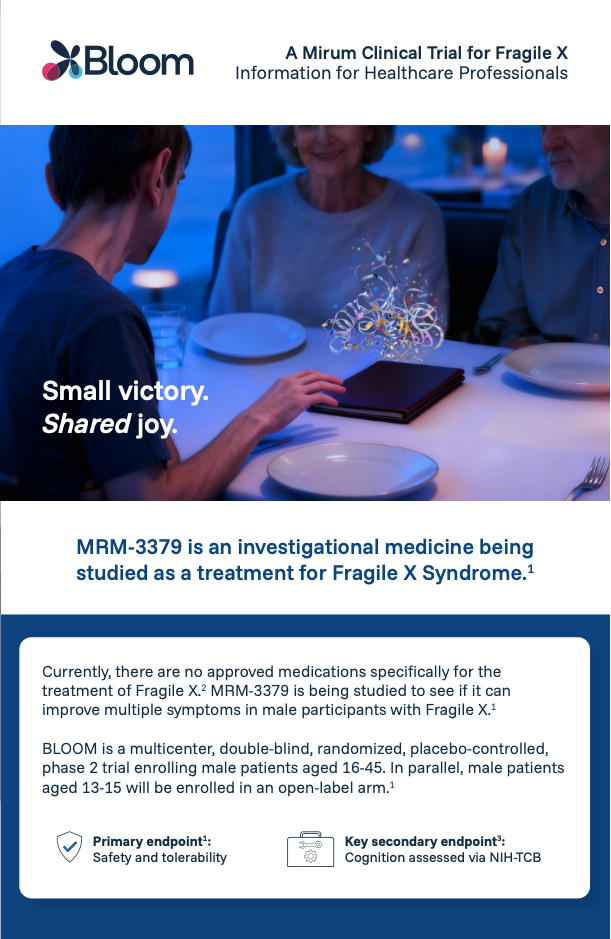
MRM-3379 is an investigational medicine being studied in the BLOOM clinical trial for Fragile X Syndrome1

Currently, there are no approved treatments for Fragile X Syndrome. The BLOOM clinical trial is studying if MRM-3379 can safely and effectively help improve certain symptoms in male participants with Fragile X Syndrome.

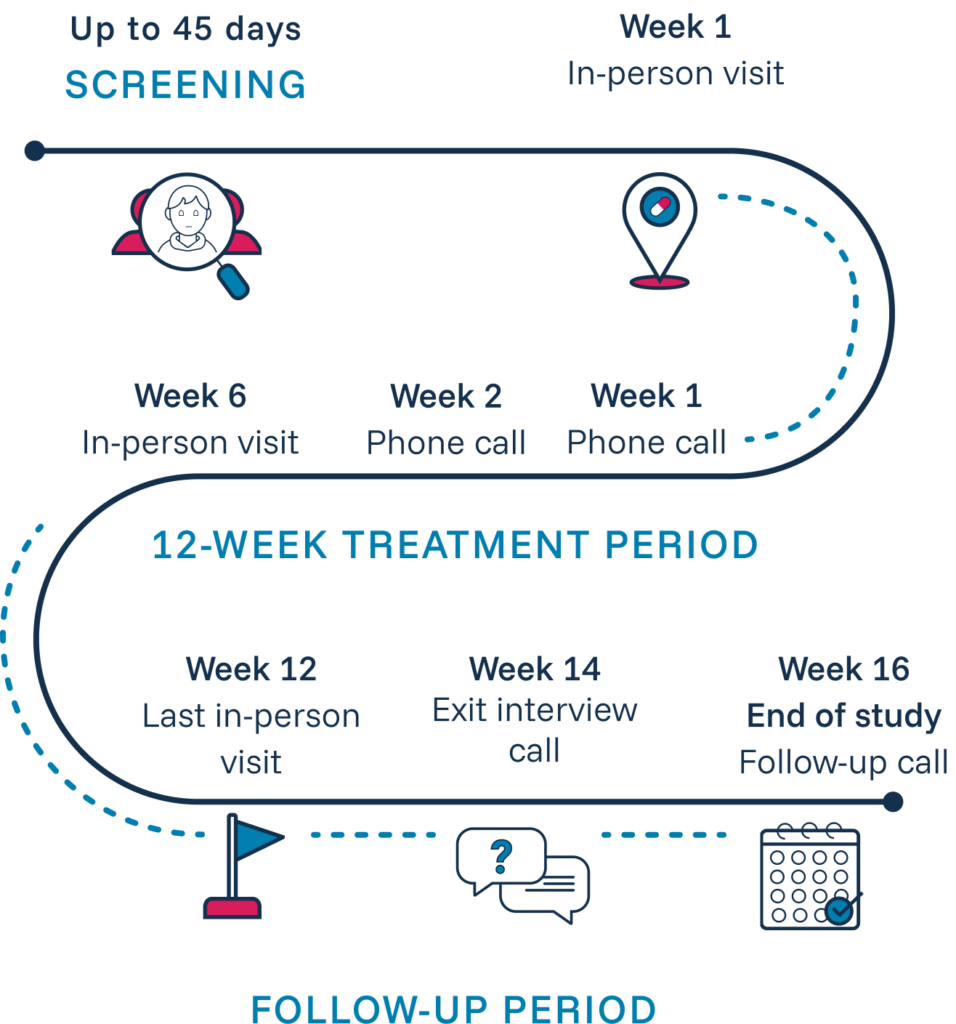
BLOOM is a multicenter, double-blind, randomized, placebo-controlled trial enrolling male patients aged 16–45. In parallel, male patients aged 13–15 will be enrolled in an open-label arm to receive MRM-3379 twice daily for 12 weeks.1

Primary endpoint icon

Primary endpoint1:
Safety and tolerability
Key secondary endpoint icon

Key secondary endpoint2:
Cognition assessed via National Institutes of Health Toolbox Cognitive Battery (NIH-TCB)

Study design for the BLOOM clinical trial1,2


Dosage1

  • Low dose
  • Medium dose
  • High dose
  • Placebo

Primary endpoint1

  • Safety and tolerability
    • Incidence and severity of treatment-emergent adverse events
    • Withdrawal due to adverse events

Key secondary endpoint2

Cognition, measured as change from baseline at Week 12 on the NIH-TCB Crystallized Cognition Composite (Picture Vocabulary Test (PVT) and Oral Reading Recognition Test (ORRT))

Trial eligibility1

Review the following criteria to determine if your male patients with Fragile X Syndrome qualify for the BLOOM clinical trial.

Open-label cohortAges: 13 to 15 years old
Double-blind cohortAges: 16 to 45 years old

Key Inclusion Criteria:
  • Willing and able to provide signed informed consent/assent. Where local regulations permit
    inclusion of participants deemed unable to provide informed consent, a legally authorized
    representative must provide informed consent on the participant’s behalf, and the participant
    must provide assent if applicable
  • Male, 13–45 years of age (inclusive)
  • Weight ≥30 kg and BMI between 18 and 40 kg/m2 (inclusive) at the screening visit
  • Diagnosis of Fragile X Syndrome with a molecular genetic >200 CGG repetitions
  • Able to perform the PVT and ORRT of the NIH-TCB
  • Have a consistent caregiver(s) who is willing and able to be present regularly and reliably
    with the participant
  • Able to swallow tablets or capsules

Key Exclusion Criteria:
  • History of or current medical condition other than Fragile X Syndrome and related issues
    that would place the participant at higher risk from trial participation

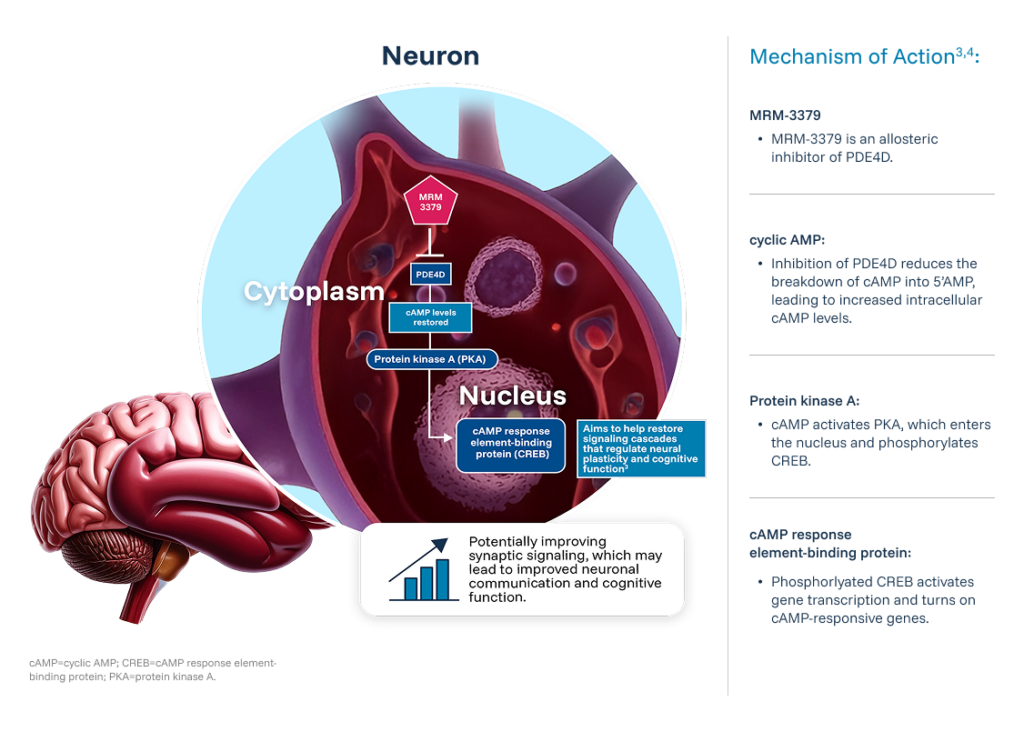
MRM-3379 proposed mechanism of action

In Fragile X Syndrome, loss of Fragile X messenger ribonucleoprotein (FMRP) is correlated with increasing disease severity. Previous studies have shown that cyclic adenosine monophosphate (cAMP) level was increased when FMRP was overexpressed and decreased when FMRP was absent. Increasing cAMP levels may help correct the signaling disruption caused by Fragile X Syndrome.3,4

MRM-3379 is an investigational medication designed to block phosphodiesterase‑4D (PDE4D) in the brain to increase cAMP levels.3,4

Talking points for conversations with caregivers about their loved one with Fragile X Syndrome

icon 1
1
Discuss the trial process and eligibility to determine if the patient is appropriate for the trial. This includes: trial timeline (including number of in-person and virtual visits), trial objective, and inclusion and exclusion criteria.
icon 2
2
Explain that while the potential effects of the investigational medication are not yet known, one of the main goals of this trial is to study cognition, as prior research shows that improvements in cognition may be closely linked to better daily function and behavior in Fragile X Syndrome.5
icon 3
3
Share helpful resources that provide detailed information about the trial and what to expect.
References
1. Clinicaltrials.gov. NCT07209462. Updated October 24, 2025. Accessed October 30, 2025. https://www.clinicaltrials.gov/study/NCT07209462 2. Data on file. Mirum Pharmaceuticals, Inc. 3. Berry-Kravis EM, Harnett MD, Reines SA, et al. Inhibition of phosphodiesterase-4D in adults with fragile X syndrome: a randomized, placebo-controlled, phase 2 clinical trial. Nat Med. 2021;27(5):862-870. doi:10.1038/s41591-021-01321-w 4. Kelley DJ, Davidson RJ, Elliott JL, et al. The Cyclic AMP Cascade Is Altered in the Fragile X Nervous System. PLoS One. 2007;2(9):e931. doi:10.1371/journal.pone.0000931 5. Dakopolos A, Condy E, Smith E, et al. Developmental associations between cognition and adaptive behavior in intellectual and developmental disability. J Neurodev Disord. 2024;16(1):31. doi:10.1186/s11689-024-09542-z

You’re now leaving the Patient and Caregiver website

Continue to Healthcare Professionals website

You’re now leaving the Patient and Caregiver website

Continue to Healthcare Professionals website

You’re now leaving the Patient and Caregiver website

Continue to Healthcare Professionals website